The European Manto
Manto Mavrogenous Square in Parikia Paros honors one of the most remarkable heroines of the Greek War of Independence. Manto Mavrogenous, the woman who captivated Europe. Her given name was Magdalene, and she was born in 1796 in Trieste. Her virtues, fame, beauty, refined manners, European style, and courageous spirit inspired the sensitive youth of Enlightenment-era Europe. A fascinating, romantic, selfless woman ,a feminist before feminism , a true Greek who made history, who knew how to love deeply, and who was betrayed in every possible way. La Bella Greca. She was the fifth child of Nikolaos and Zacharati Mavrogenous, from a distinguished family with roots in Paros and origins in Mykonos. Expelled from Moldavia before the Revolution of 1821, she lived in the Greek community of Trieste. The daughter of a merchant and prince of Moldavia, raised in comfort and European elegance, Manto received an advanced education, spoke French, Italian, and Turkish, and was baptized in the Orthodox faith.
Her Origins and Education
From a young age, she was immersed in the spirit of the Enlightenment. Her father was a member of the Filiki Eteria (Society of Friends) and a financial benefactor of the revolutionary fighter Lambros Katsonis. Thus, a delicate revolutionary was born into a bleeding Greece. In 1818 she lost her father and moved to Tinos under the protection of her uncle, the priest Papamavros, also a member of the Filiki Eteria. There, she received news of the uprising and was sent to Mykonos, where she led the islanders’ revolt. Using her dowry, she equipped two ships and manned them for immediate participation in the struggle. In 1821, four more ships were outfitted at her own expense and joined Admiral Tombazis’s fleet. For the cause, she spent 700 million grosia equivalent to one million gold francs at the time. She dedicated her entire vast estate, offering even her most beloved possessions and jewelry.
Decision for the Homeland
In 1822, as commander of the fleet, she repelled the Algerian attack and organized an infantry corps composed of six detachments of fifty men each, which supported the land battles she herself accompanied them to Euboea, Pelion, Livadeia, and Phthiotis. How is it possible, however, that no Greek historian except Nikolaos Dragoumis has mentioned this extraordinary, selfless, and daring figure with her immeasurable contribution to the liberation struggle. A feminist before feminism, Manto Mavrogenous “the beautiful daughter of Mykonos,” as Pouqueville called her was a tall, graceful, proud, and courageous young woman, raised with patriotism and piety by her priest uncle, Mavros. At the council of Mykonos notables in a strictly male dominated environment she stood tall and declared enthusiastically: “I come to offer my fortune for the struggle of our Nation. Let us not waste time. Forward! Let our ships take to the sea. Let us not be the last to proclaim our independence!” This declaration caused a rift with her family. Her mother refused to watch her empty the family coffers to arm warships. But Manto had only one answer: “May my homeland be free and I care not what becomes of me.”
A Romantic Idol for the Philhellenes
For the Philhellenes, Manto Mavrogenous became a radiant romantic ideal a living embodiment of the struggle for freedom and the noble spirit of Enlightenment Europe. In her courage and beauty, the young men and women of Europe saw reflected the highest ideals of Liberty, Equality, and Fraternity, but also the power of an educated, independent woman who defied convention and destiny alike. “My love for my country, my devotion to my religion, and my thirst for just revenge have filled my soul with wild fervor and fighting spirit. I long for a day of battle as you long for a dance.” She wrote passionately in one of her letters to the ladies of Paris, appealing for moral and financial support for the Greek cause. Her words carried both elegance and fire a woman’s voice that blended tenderness with defiance. “There is no common trait except the natural graces with which Heaven endowed us. We differ even in how we use them. You employ them against their true purpose, representing mere passive beings. Happier I, I have given my charms a useful destiny for glory and for the great benefit of mankind.” Through such letters, Manto transformed herself from a noblewoman of Mykonos into an international symbol of female strength and revolutionary virtue.
A Symbol of Courage for Europe
In 1825, the great French Philhellene Ginouvier published a romantic novella about Manto Mavrogenous in Paris, which sold out immediately and stirred deep admiration among European readers. The story transformed her into a symbol not only of courage and self sacrifice but also of the timeless struggle for liberty. Across salons and universities, her name became synonymous with the bravery of Greek women who dared to fight beside men and suffer for the same ideals.
That same year, however, found her living in Nauplion, in a half ruined house open to the wind and salt of the sea, selling the last remnants of her once vast estate simply to survive. Her pride would not allow her to beg; instead, she quietly parted with the treasures of her youth. The following year, she sold her jewelry to care for the Greek refugees who had survived the heroic Exodus of Messolonghi ornate gold rings, emerald earrings, ruby studded crosses, her golden watch, a pearl necklace, and other cherished family heirlooms each piece a fragment of a past life offered to ease the suffering of her people.
Europe’s Fascination and Her Love for Dimitrios Ypsilantis: Love and Betrayal
Her acquaintance with Dimitrios Ypsilantis led to a much discussed romantic relationship. Her house was looted twice as punishment for the freedom with which she lived her affair. They had even exchanged a promise of marriage .Ypsilantis drafted a contract pledging to marry her when the Revolution ended.
But she was slandered by Ioannis Kolettis, who viewed the brilliant, proRussian couple with hostility. He spread rumors that Manto was unfaithful to Ypsilantis with the British agent Edward Blaquière, who had come to Greece to oversee the second installment of the English loan. These rumors cooled their relationship and eventually destroyed it.
Ypsilantis broke his promise, and Manto the most sought-after bride of her time was left unmarried and exposed to the gossip of the era, soon falling into poverty and depression. Her angry letters to the government and to Ypsilantis himself reflect her despair, loneliness, and sense of injustice.
To make matters worse, anti-Russian circles arranged her abduction using Ypsilantis own guards, who took her back to her island and forbade her from ever returning to Nauplion to see him.
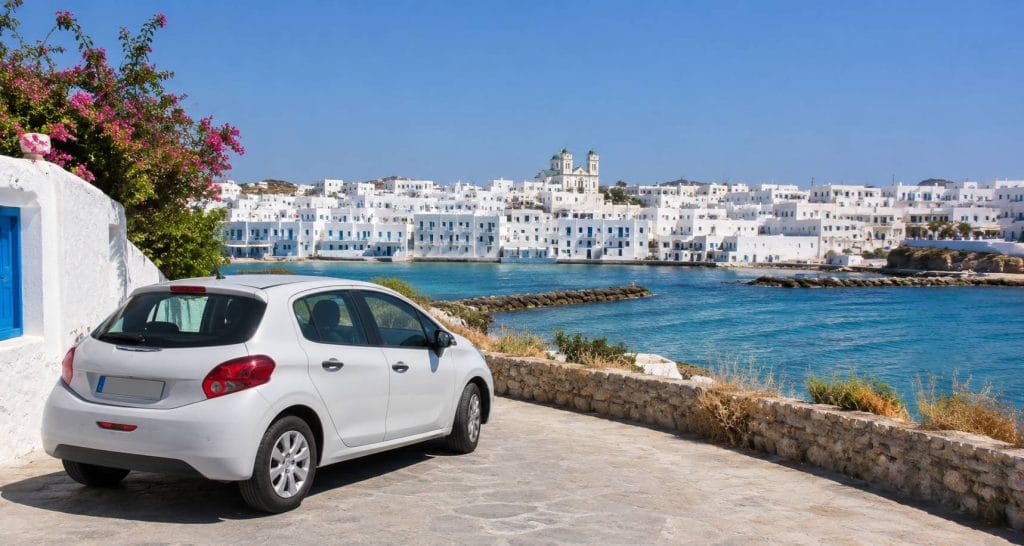
To explore the full history of Paros and visit its museums, book your rental car here.
Ioannis Kapodistrias and Her Recognition
Ioannis Kapodistrias was the only one who truly recognized her sacrifices. He granted her an honorary pension and arranged a temporary residence for her. More importantly, he appointed her overseer of the orphanage he had founded. He also bestowed upon her the rank of Major General, and she, ever generous, reciprocated by gifting him a family heirloom sword engraved with the words:
“Judge, O Lord, those who wrong me; fight against those who fight against me; reign over the rulers of men.”
After the assassination of Kapodistrias, however, all these privileges were revoked. Manto became destitute a lonely woman facing not only abandonment but also the death of Ypsilantis. Her grief turned to mourning; she followed his funeral procession as his true widow and left Nauplion forever, seeking refuge on the beautiful island of Paros.
Her Last Years in Paros
Manto arrived in Paros to stay at her uncle’s house and sent a letter to King Otto, requesting a modest pension, as every last trace of her fortune had been sold or looted. No reply ever came. She sent a second letter, again, no response.
By July 1840, the once radiant and beautiful noblewoman had reached the age of 44. At the final crossroads of her fate, she was struck by typhoid fever and passed away, making Paros her final resting place.
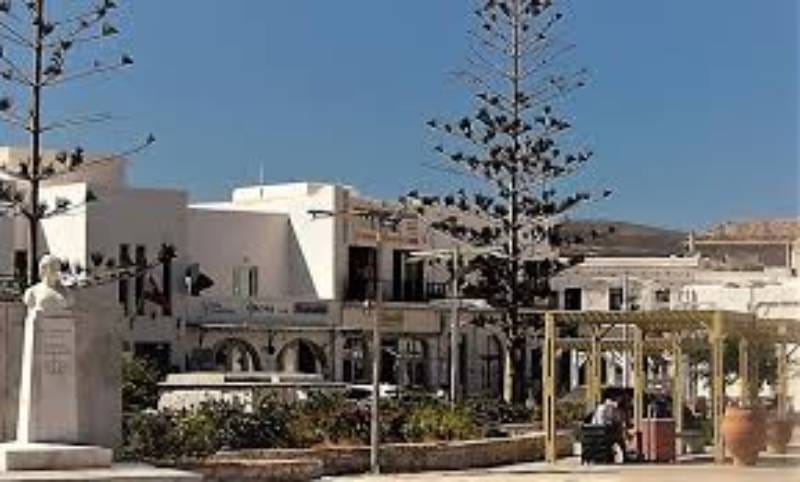
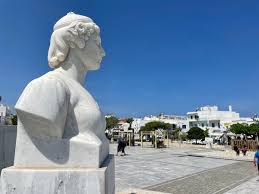
The bells of the Church of Panagia Ekatontapyliani tolled mournfully. Manto Mavrogenous died of typhus, impoverished and alone. The marble plaque marking her grave once stood in the courtyard of the church, just a few minutes’ walk from Manto Mavrogenous Square in Parikia, where her bust stands today.
After the restoration of the church courtyard in 1961, the plaque was removed and the exact location of her grave was lost, depriving the islanders of a sacred place of remembrance: the final resting place of their beloved heroine, their island’s own saint. To explore Paros in comfort, book your rental car here and secure the ideal vehicle for your vacation from Acecarsparos rent a car.
Her Memory in Paros and Modern Times
In 1922, after the Asia Minor Catastrophe, refugee families settled on the island. The Asia Minor Greeks integrated and enriched the local society both culturally and economically. Those who settled in Paros revitalized agriculture, which had not been systematically developed on the island. In Parikia, refugee families established aneighborhood known as Prosfigika, located along the town’s pedestrian street. The most important summer celebration held in Parikia is the Feast of the Virgin Mary of Ekatontapyliani on August 15th. Another major festivity is organized every year by the Paros Commercial Association on the Feast of the Ascension, at the chapel of Saint Phokas, on the northwestern cape of Parikia Bay. This celebration was first started in 1929 by the café owners of Parikia, when cafés also served as small grocery stores. They would carry tables, chairs, cauldrons, and food to the chapel on the eve of the feast, and on the day itself, musicians with bagpipes, violins, and lutes would accompany the dances held after the liturgy. In the center of Parikia stands her bust, at Manto Mavrogenous Square, a landmark and point of reference for every visitor to the island. To discover another one of Paros’ most iconic villages, continue with our full guide to Naoussa, its harbor, history, beaches and unique atmosphere.